Welcome to the
world of ARTES 4.0
Advanced robotics and enabling
digital Technologies and Systems
News and Events
News ed eventi
ARTES 4.0 to Pontedera’s Top Graduates: Research and Industry Just Steps Away from Your Schools
9 September 2026
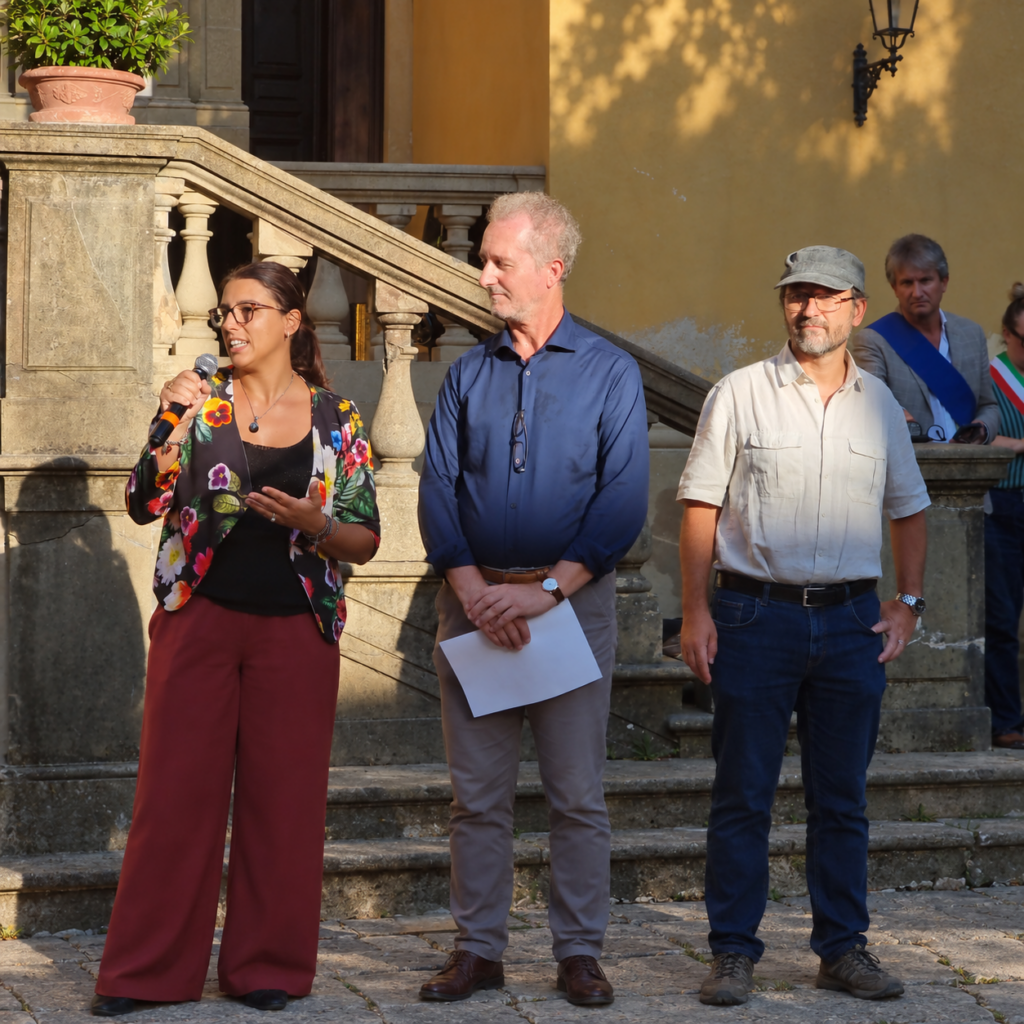
A final grade of 100/100 on a school-leaving certificate reflects many hours of study and raises a question: which path should students take after graduation? At Villa Crastan in Pontedera, the ceremony honouring students from upper secondary schools across Pontedera and the Valdera area who completed their final State examination with a score of 100/100 or 100/100 cum laude combined recognition of their achievement with an exploration of the opportunities available locally.
The garden of the historic villa hosted the traditional awards ceremony for the highest-achieving graduates, attended by students, their families and representatives of their municipalities. Sixty-six students received an award, the majority of them young women, from several towns across the Valdera area. The presentation of the certificates, a tradition spanning more than twenty years, brought together school heads, teachers, local administrators and organisations active within the area’s research and education ecosystem, including the ARTES 4.0 Competence Center. Alongside the grades and names of the award recipients, one question emerged: what can the local area offer young people who, after leaving school, must decide where to study, work or put their abilities to the test?
ARTES 4.0 and its connection with Pontedera
Clementina Cruceli, Coordinator and Deputy Executive Director of the Competence Center, spoke on behalf of ARTES 4.0. Her remarks began with a personal journey rooted in the area’s scientific history: her studies in Biomedical Engineering in Pisa, followed by education and work at the Sant’Anna School of Advanced Studies and, finally, her current role at ARTES 4.0. The experience she shared with the graduates illustrates how Pontedera can provide the conditions for building a scientific and professional career by drawing on expertise developed in local schools, universities, laboratories and businesses.
ARTES 4.0 is one of Italy’s eight Competence Centers established under the Industry 4.0 Plan to support companies in adopting advanced digital technologies. Its headquarters are located in the Pontedera area because this compact yet exceptionally dynamic setting brings together expertise in robotics, artificial intelligence, bioengineering, design and industrial processes. This wealth of knowledge makes the area one of Italy’s leading hubs for the development and application of advanced technologies.
Clementina Cruceli described this ecosystem through the concept of the Innovation Mile: a hub where the ARTES 4.0 Competence Center, the BioRobotics Institute of the Sant’Anna School of Advanced Studies, the Pont-Tech incubator, Piaggio, technology companies, startups founded by young entrepreneurs and educational institutions such as the Modartech Institute all operate side by side.
The strength of the Innovation Mile extends beyond geographical proximity. Laboratories, companies and educational programmes foster a continuous exchange of people and knowledge, enabling research projects to find industrial applications, students to connect with companies and young businesses to access specialised expertise.
Studying artificial intelligence to guide its use
The discussion with the highest-achieving graduates also addressed artificial intelligence, which is often viewed through two opposing reactions: fear and unreserved enthusiasm. Both attitudes can overshadow a genuine understanding of the technology. As Clementina Cruceli explained, studying AI means learning to recognise its capabilities, limitations and consequences. Technical expertise must be accompanied by awareness, ethical judgement and the ability to assess the purposes for which such a powerful tool is used. For young people preparing to enter university or the world of work, AI literacy will be relevant to almost every professional field, from medicine and manufacturing to communication and design.
The award recipients were therefore encouraged to continue their education while remaining aware of the opportunities already available around them. Pontedera is home to laboratories, companies and centres where knowledge can be transformed into technologies, services and new professions. The mile described by Clementina Cruceli reflects the short distance separating local schools from some of Italy’s most advanced research centres, pointing graduates towards a real environment in which they can put their skills, curiosity and ambitions to work.
News ed eventi
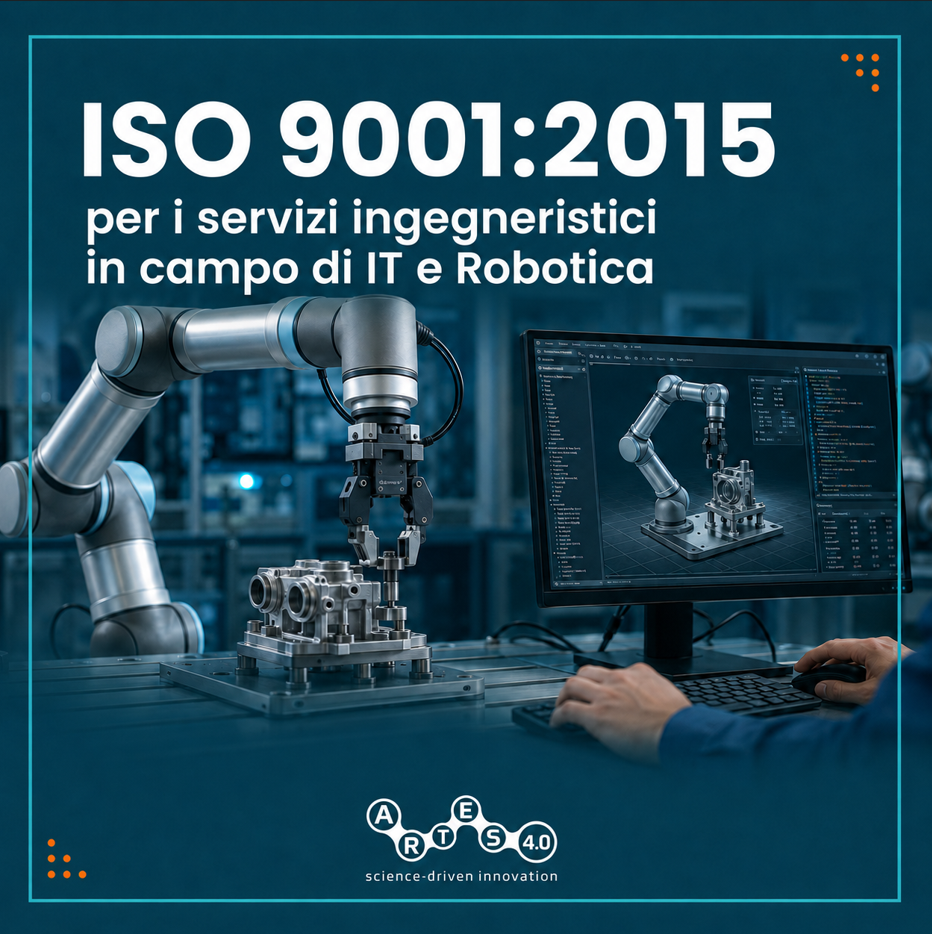
ARTES 4.0 achieves ISO 9001:2015 certification
3 September 2026
The ARTES 4.0 Competence Center has achieved certification of its quality management system to ISO 9001:2015 for engineering services in IT and robotics.
Issued following an assessment by a third-party body, the certification confirms that the management system meets the requirements of the international standard. Companies can use this certification when selecting and qualifying ARTES 4.0 as a technology partner.
When a company commissions engineering work, it assesses both technical expertise and how the work will be organized. Defining project requirements, assigning responsibilities, verifying the work performed and addressing any issues all influence collaboration between the parties. ISO 9001:2015 sets out requirements for managing these aspects through an approach based on customer focus, process control, the assessment of risks and opportunities, and continual improvement.
For ARTES 4.0, quality management supports technology transfer: helping companies identify, test and adopt technologies suited to their production needs. In this work, technical decisions take into account project objectives, operational constraints and the conditions in which the solutions will be used.
The certification provides companies and their technical and procurement departments with a documented basis for assessing the management system for engineering services, alongside the Center’s expertise and experience.
Robotica e Intelligenza Artificiale
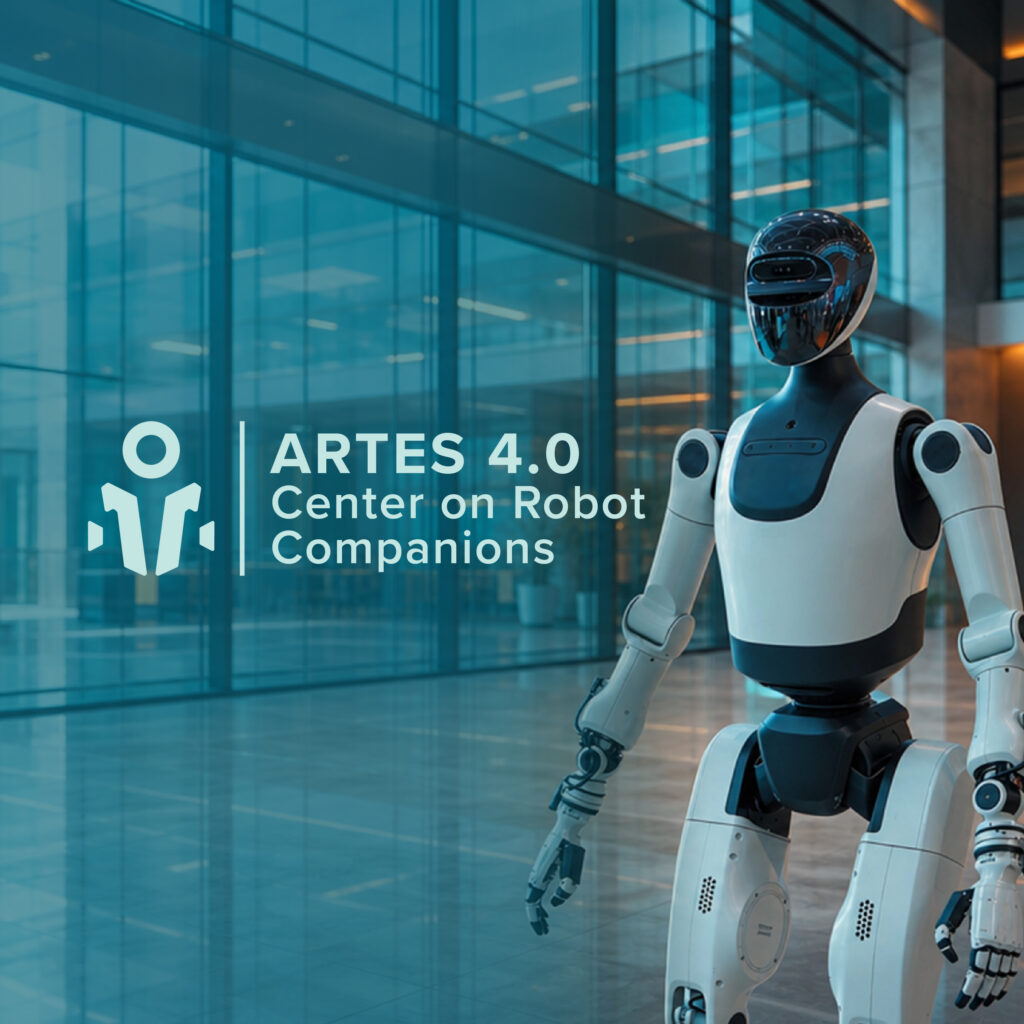
Test robots before investing: ARTES 4.0 launches the Center on Robot Companions in Pontedera
8 June 2026
Test a robot before integrating it into a company. Measure its performance, safety, usability and operational impact. Determine in advance whether a robotic or artificial intelligence technology can improve a process, automate a repetitive task, support a service and be introduced responsibly into its human and organisational setting. Also assess how a robot should be designed in terms of form, interaction and user experience through dedicated design work that brings the value of Italian design culture to companion robotics: appearance, functionality, design quality, user focus and consistency with the intended use context.
These are the objectives behind the ARTES 4.0 Center on Robot Companions, the new facility of the ARTES 4.0 Competence Center, designed for testing humanoid and animal-like robots, drones, robotic interfaces and immersive systems, all already on site and available for testing, development and application-oriented design. The Center on Robot Companions is already operational and is located on Viale Piaggio in Pontedera, within the facility that houses ARTES 4.0's headquarters; it will be officially inaugurated in the autumn.
Spanning approximately 520 square metres, with 26 items of equipment available on site and a total investment of €1.2 million, the Center on Robot Companions is the first facility of its kind in Italy and one of only a few in Europe devoted entirely to applied testing of companion robots and artificial intelligence solutions integrated into perception, control, interaction, data analysis and decision-support processes.
The Center was established to help companies, public bodies and organisations move from curiosity about robotics to a concrete assessment based on measurements, data and application scenarios. Its purpose is to enable companies to test robots before adopting them and measure their impact before investing. This allows organisations to reduce the technological, economic and operational risks associated with introducing new robotic solutions. The activities of the Center on Robot Companions focus on supporting technologies that are already sufficiently mature and integrating them into business processes (in technical terms, these are high-TRL services, with TRL, Technology Readiness Level, being the scale used to measure a technology's maturity).
Alongside technical testing, the Center on Robot Companions provides an additional assurance of the quality, reliability and responsible use of robotic solutions by verifying the technology's origin, how it is managed and the conditions under which it is used. Each robotic solution is assessed not only according to the performance it can deliver, but also according to whether its origin, operation, traceability and management throughout its use can be fully understood.
The aim is to ensure that robots, platforms and equipment can be introduced into real-world settings in a safe, transparent and understandable way, in accordance with the ethical, professional and regulatory principles that must guide the use of intelligent systems in workplaces, services and everyday life. This assurance function is what makes the Center on Robot Companions a distinctive, advanced facility for technology transfer applied to companion robotics and artificial intelligence.
The Center on Robot Companions has been established within ARTES 4.0, a national Competence Center selected by the Ministry of Enterprises and Made in Italy and specialising in robotics and artificial intelligence. Companies can therefore access the specialist expertise and research capabilities of ARTES 4.0's national ecosystem of excellence, starting with those of the Sant'Anna School of Advanced Studies in Pisa, a founding member of the Competence Center and a leading scientific institution in robotics, biorobotics and artificial intelligence, as well as in the interdisciplinary study of the relationship between people and intelligent systems. In the latest edition of the ShanghaiRanking's Global Ranking of Academic Subjects, the Sant'Anna School of Advanced Studies ranked seventh worldwide and second in Europe in Robotics Science & Engineering.
The Center on Robot Companions in Pontedera offers a technological infrastructure designed to simulate a wide range of testing scenarios, including humanoid robots for service and assistance activities; quadruped robots for monitoring and inspection trials; bionic torsos for studying new forms of human-machine communication; drones and 3D acquisition systems for reconstructing real-world environments; wearable technologies, headsets and immersive platforms for teleoperation; and 3D printing tools, advanced computing infrastructure and test environments for artificial intelligence applications.
Technology neutrality is one of the distinctive features of the Center on Robot Companions. The facility is not tied to a single manufacturer or specific platform, but makes it possible to work with different solutions and conduct comparative assessments of technologies, configurations and use cases. This enables companies to use comparable data to determine which solution best meets their application needs and integration requirements.
In addition to testing and comparative technology assessment, the Center works on the design of companion robots. Form, behaviour, movement, interfaces, degree of autonomy, perceived safety and consistency with the use context are all considered when determining whether a robot can actually be adopted. The Center can also assess a solution's ability to operate in physical spaces, interact with people, build trust and integrate into processes without creating unnecessary complexity.
The Center also stands out for its interdisciplinary approach. Companion robotics and artificial intelligence raise ethical, philosophical, social and organisational questions: the relationship between humans and machines, trust, responsibility, social acceptability, quality of interaction and the impact on work. This means that every potential application can be assessed, with the support of specialist academic expertise, for its consistency with the human and social context into which the robot would be introduced.
This approach is further enriched by the link with the Robo-Philosophy group at the Sant'Anna School of Advanced Studies, which has just organised the Seasonal School Robo-Philosophy: Dimensions of Co-Agency, dedicated to the philosophical, social, political and ethical dimensions of co-agency between people and robotic systems.
ARTES 4.0 takes a responsible approach to innovation by integrating scientific knowledge, technological capabilities, attention to legal and regulatory issues, awareness of social consequences and respect for the principles that should guide the introduction of intelligent systems into the lives of people and organisations. The Center on Robot Companions was therefore established not only to verify whether a technology works, but also to help determine whether it can be adopted safely, in an acceptable manner and in compliance with regulations in the environments where it will be used.
The Center in Pontedera is part of a network of locations and facilities that strengthens ARTES 4.0's ability to support companies across Italy. Alongside its headquarters on Viale Piaggio, the Palermo, Olbia and Jesi sites are connected to the Center on Robot Companions. The new Center also helps strengthen the Joint Lab established with CIM in Turin, dedicated to robotics in support of manufacturing companies, thereby expanding opportunities for testing and technology transfer to industry. It also contributes to other international initiatives that ARTES 4.0 is undertaking to offer products on a global scale.
“With the Center on Robot Companions,” emphasises Professor Paolo Dario, Scientific Director of ARTES 4.0, “a new phase is beginning for technology transfer in our area. Pontedera has always been a place where industry, research and a vision of the future come together: from its great manufacturing tradition to the emergence of world-class scientific expertise in robotics. This Center brings that heritage together and projects it towards the frontier of robots entering workplaces, services and everyday life. It has chosen to do so through an open infrastructure that enables companies to engage with robotics with the support of the very best research ”.
“Companies' competitiveness will increasingly depend on their ability to test advanced technologies before adopting them,” explains Antonio Frisoli, President of ARTES 4.0, -. “One challenge for the Center, for example, is to verify whether new advanced humanoid robotics platforms can actually be programmed to perform real tasks in industrial settings, using the latest Visual Action Models, which make it possible to train robots by presenting them with examples. This is precisely why the Center also has a computing infrastructure that allows different generative AI models for robot control to be validated ”. With the Center on Robot Companions, ARTES 4.0 offers companies a place where they can carry out these checks before investing: “Physical AI makes this challenge even more tangible because it brings artificial intelligence into machines capable of perceiving, moving and acting in the real world.”
Download Brochure
Take a brief look at our innovation services in Industry 4.0 and 5.0
1/1